Father’s Day in Latvia is more than a holiday – it is an opportunity for society to express respect and gratitude to fathers for their presence, responsibility and love. Although this tradition is relatively new in our culture, its roots are deep – they grow from the desire to strengthen family ties and honor the important role of the father in the life of a child.
Let’s look at the history of Father’s Day in the world and in Latvia, studying how a tradition is born from an idea – and how each of us, with our own participation, can give it meaning. We, the “Parents’ Organization for Moms and Dads”, can proudly say that we have stood at the “cradle” of the emergence of Father’s Day in Latvia, turning it from an entry in the law into a lively, heartfelt and anticipated public event.
Father’s Day in the USA
Unlike many holidays that have a single, clear source, the idea for Father’s Day in the United States arose from two independent but similarly motivated events that marked a long road to national recognition. The first documented ceremony honoring fathers took place on July 5, 1908, in Fairmont, West Virginia. The previous December, the Monongahena Mine explosion had killed 361 men, 250 of whom were fathers, leaving about a thousand children without breadwinners. Grace Golden Clayton, who was grieving the loss of her own father, suggested that a local pastor hold a one-time memorial service to honor these men.
The idea that eventually spread nationwide originated a year later in Spokane, Washington. Sonora Smart Dodd, while listening to a Mother’s Day sermon in 1909, felt that fathers deserved similar recognition. Her motivation was deeply personal—her father, Civil War veteran William Jackson Smart, was a widower who raised Sonora and her five siblings alone. With the help of local churches, store owners, and government officials, she managed to garner support for her idea, and on June 19, 1910—her father’s birth month—the first official Father’s Day was celebrated in Washington state.
The long road to national recognition
Although Dodd’s initiative was well received, it took more than 60 years for Father’s Day to become an official national holiday. The first bill was introduced in Congress in 1913. President Woodrow Wilson supported the celebration in Spokane in 1916, but Congress resisted, fearing commercialization. President Calvin Coolidge recommended that states celebrate the day in 1924, but did not declare it national.
There were two main reasons for this: first, the aforementioned fear of commercialization, and second, the perception that such sentimental holidays were “unmanly” and merely mimicked Mother’s Day. This suggests that in society at the time, the role of the mother as a caring and nurturing person was considered worthy of public celebration, while the role of the father as a provider and disciplinarian was not.
Paradoxically, it was commercial interests that helped the holiday spread. During the Great Depression, Sonora Doda renewed her campaign, this time with the support of manufacturers of goods that benefited from such a holiday, such as tie and pipe manufacturers. While this helped to boost its popularity, it also drew skepticism from some members of the public, who viewed the holiday as a marketing ploy.
Things began to change after World War II, when the holiday was redefined as a way to honor veterans and men who had fought for their country. Finally, in 1966, President Lyndon Johnson issued the first presidential proclamation declaring the third Sunday in June as Father’s Day. However, it was not until 1972 that President Richard Nixon signed the law making Father’s Day a permanent national holiday.
Although the modern form of Father’s Day was “invented” in America, the idea of honoring fathers has much older roots, stretching back centuries and deeply rooted in religious traditions. These ancient roots help explain why the holiday is celebrated on such different dates and in such different ways around the world.
Catholic European Tradition: Saint Joseph’s Day
In Catholic Europe, fatherhood has been celebrated since the Middle Ages, celebrated on March 19, St. Joseph’s Day. St. Joseph, the foster father of Jesus Christ, is the archetype of the ideal father and husband in the Catholic tradition. This tradition, which began as early as the 14th or 15th century, apparently at the initiative of the Franciscans, was actively supported by the church. Spanish and Portuguese colonists later took this tradition to the Americas.
Echoes of the past
There is evidence of even older forms of father-honoring. Archaeologists have found a nearly 4,000-year-old Babylonian clay tablet on which a son named Elmesu wishes his father health and long life—essentially an ancient greeting card. The Coptic Orthodox Church also celebrates fatherhood on Saint Joseph’s Day, but on July 20, a tradition that may have begun as early as the fifth century.
The American holiday arose from the initiative of specific activists, while the European tradition “evolved” organically from centuries-old religious customs that have no single founder or starting date. This distinction between secular, activist-created and religious, traditional origins largely explains the diversity we see today. Countries with strong Catholic roots, such as Spain, Italy, and Portugal, were able to easily adapt the modern idea of Father’s Day to their already existing March 19 celebrations. In turn, countries without such a tradition either imported the American model with the entire date or adapted it to some other local custom, as happened in Germany.
Germany – from Vatertag to Männertag
In Germany, Father’s Day (Vatertag) is celebrated on Ascension Day, a public holiday 40 days after Easter. The connection is symbolic, but the modern tradition is far from religious. The day is more commonly known as Männertag (Men’s Day) or Herrentag (Gentlemen’s Day). It is a day when groups of men (not just fathers) go on hikes or bike rides, pulling small handcarts filled with beer and snacks. It is a loud and cheerful celebration of male friendship, often unrelated to family and sometimes leading to a high number of alcohol-related accidents. The tradition has evolved from medieval Ascension Day processions, where the father with the most children received a ham as a prize, to 19th-century “gentlemen’s parties” and nature hikes.
Spain – religious integration
Spain, like other Catholic countries, celebrates Father’s Day on March 19, Saint Joseph’s Day, which is an official holiday in some regions. The celebration is closely linked to religion and family. Traditions include attending church services, festive family meals, and gifts or self-composed poems by children for fathers. The father is honored here as the archetype of the head of the Holy Family. Although the date is ancient, the modern commercial and sentimental aspects, such as gift-buying, were adopted from the American model in the mid-20th century, but were organically integrated into the already existing religious framework.
Australia – A Spring and Family Celebration
Australia and New Zealand celebrate Father’s Day on the first Sunday in September. This date was likely chosen for practical reasons – it marks the start of spring and fills the commercial calendar between Mother’s Day in May and Christmas. Initially, the holiday was greeted with skepticism and cynicism in Australia, seeing it as an unnecessary American import and a threat to traditional masculinity. However, today the celebration is very popular and closely associated with the pleasant spring weather. It is characterized by outdoor activities – family barbecues, picnics in parks and sports games. Although gift-giving is common, research shows that spending on this holiday is significantly lower than on Mother’s Day, emphasizing that the main thing is time spent together, not gifts.
Father’s Day in Latvia – the birth of a new tradition
In Latvia, Father’s Day is a relatively new phenomenon that offers a unique opportunity to observe how a cultural tradition is being created from scratch in today’s globalized world.
Official recognition of Father’s Day in Latvia
In Latvia, Father’s Day was officially included as a day to be celebrated in 2010 in the law “On holidays, remembrance and days to be celebrated” – it is celebrated on the second Sunday of September. Although the day was established by law, it became a real tradition, largely thanks to the Parents’ Organization for Moms and Dads. Since the inclusion of Father’s Day in the calendar of celebrated days, the organization began to organize extensive activities, creating an idea in society about why it is important to celebrate not only Mother’s Day, but also Father’s Day, as well as providing ideas on how to establish this day as an annual family tradition.
Creating and popularizing a tradition
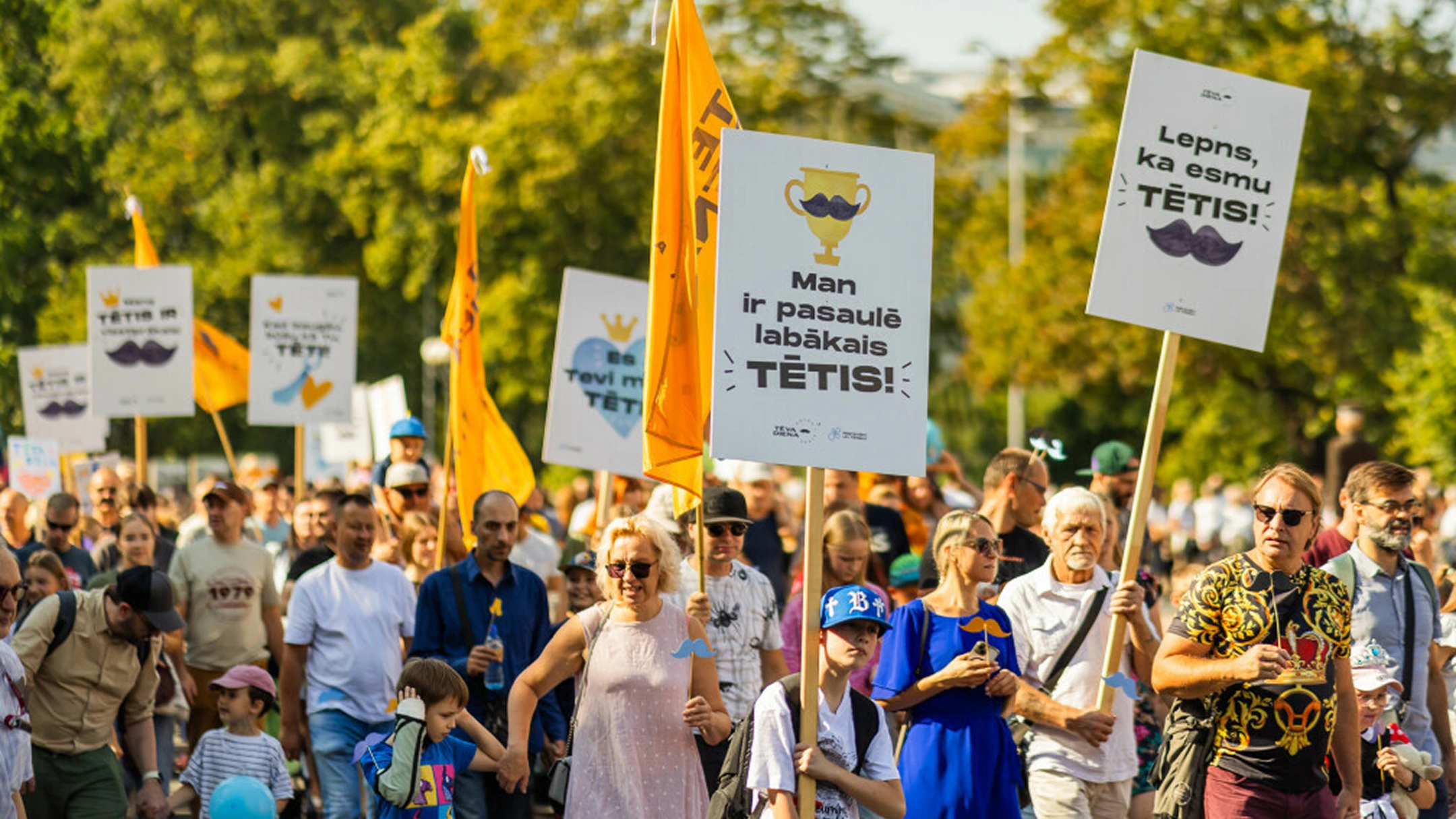
The Parents’ Organization for Moms and Dads organized the first Father’s Day parade and festival in Riga on the second Sunday of September 2013 (September 7). The parade took place along Brīvības Street, closing traffic. The head of the organization, Inga Akmentiņa-Smildziņa, pointed out at the time that they had cherished this idea for several years and now it has gradually turned into an annual tradition – the parade and festival are still taking place in Vērmanes Garden, the central slogan of the parade is: “Proud to be a father!”.
Timeline
- 2010 – Father’s Day is legally established as a day to be celebrated – on the second Sunday of September
- 2013 – the first Father’s Day parade and festival in Riga starts, initiated by the “Parents’ Organization for Moms and Dads”
- 2024 – the eleventh parade and festival gathers over 12,000 visitors


